What to ask about access before visiting a bookshop
Plan a bookshop visit with specific questions about entrances, floors, seating and communication, plus a message template and a way to record uncertain details.
By Creasy Spines · · Sources and method below
The short answer
Start with the arrangements that matter to you, then ask the shop specific questions about the entrance, the sections you want to browse and any facilities or assistance you need. Confirm the exact branch and visit date. A step-free label is a useful starting point, but it does not describe every doorway, floor, toilet or event space. Keep unanswered questions marked as unknown.
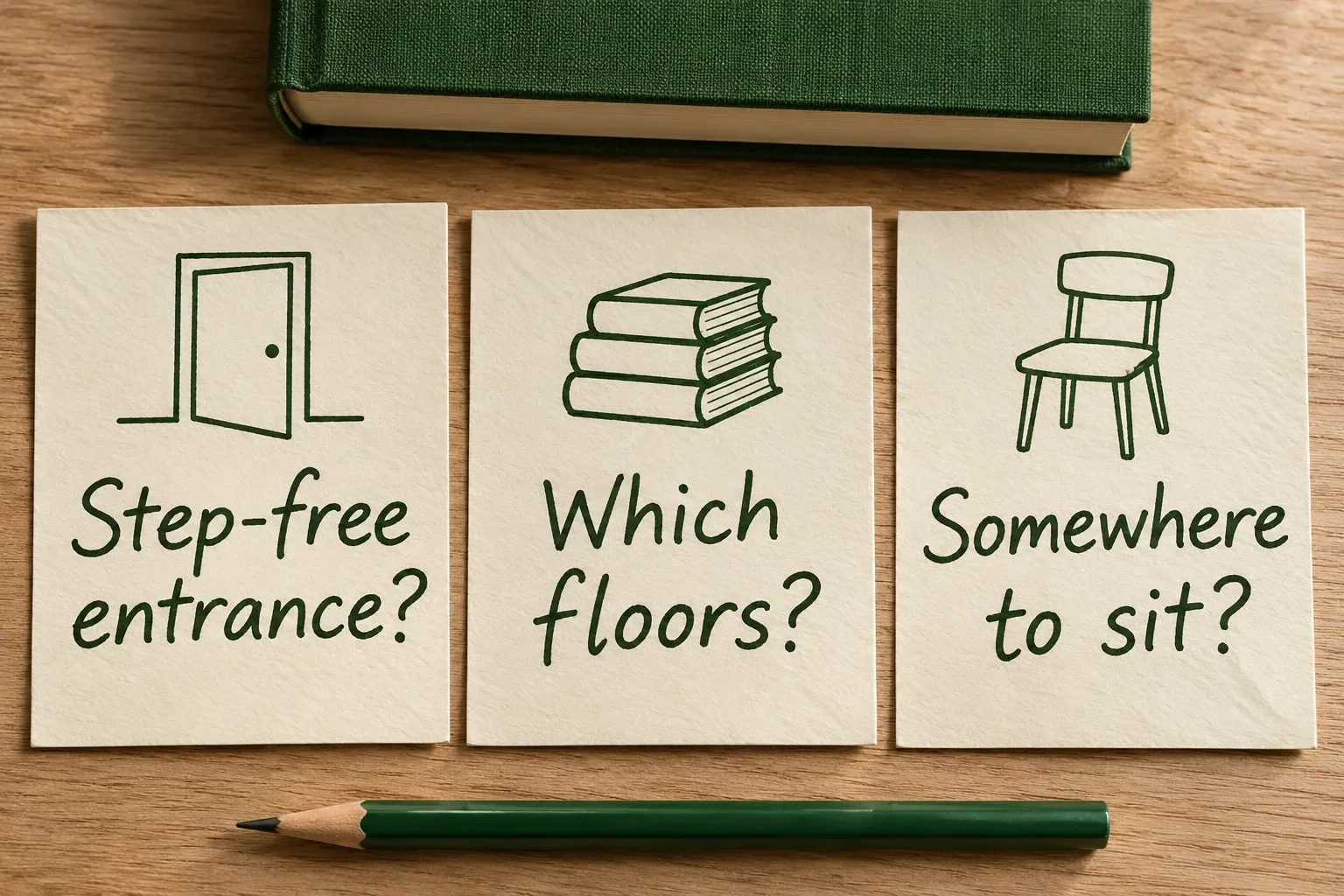
Start with your own short access checklist
Write down the two or three details that would decide whether the visit works for you. These might be reaching a particular section without steps, having somewhere to sit, communicating in writing or avoiding a crowded event. Separate essential arrangements from preferences so your enquiry stays focused.
The Bookshop Atlas offers a Step-free filter and links to shop records. Use it to find possibilities, then consult the shop’s own information. Atlas records come partly from OpenStreetMap and can be incomplete; the absence of a facility from a listing does not establish that it is unavailable. Likewise, a recorded label is not a personal access assessment.
Sources: 1
Ask which entrance reaches the books you want
An address and an entrance are not always the same instruction. Readings State Library’s own page, checked on 6 November 2026, describes stairs at the Russell Street entrance and directs visitors needing an accessible entrance to La Trobe Street. State Library Victoria’s access page separately identifies Entry 5 on La Trobe Street for the Russell Street Welcome Zone. This is an example of why an entrance description is more useful than a general yes or no.
For any shop, ask where to enter, whether the route includes a threshold or steps, and which book floors you can reach from there. If a door or lift’s dimensions matter to your visit, request the relevant measurements. If a portable ramp or staff assistance is needed, ask how to request it and whether it will be available at your planned time. These are questions to resolve with the venue, not facilities every shop is assumed to provide.
- Which entrance should I use, and how can I recognise it?
- Can I get from that entrance to the section I want without steps?
- If the route depends on a lift or ramp, is it available during my visit?
Check the parts of browsing that a doorway label misses
Access information can describe practical help as well as the building. For example, Readings Carlton’s page says staff can help with hard-to-reach books and provide pen and paper for communication. That is a published statement about that branch, not a promise on behalf of other shops. Ask for the arrangement you need at the branch you intend to visit.
Choose the relevant questions below rather than sending the whole list. For an author talk, check the actual event room and entrance separately. State Library Victoria’s access page lists hearing-loop provision by venue and explains how to enquire about portable units for tours; a facility in one space should not be assumed to cover another.
- Browsing: are the aisles and turning spaces suitable for my needs, and can staff retrieve books if a shelf is out of reach?
- Resting: is seating available, and can I use it while deciding between books?
- Toilets: is there a customer toilet with the features I need, and can I reach it from the shop?
- Sensory conditions: when is the shop usually quieter, and are there planned events or background music?
- Communication and events: can we communicate in writing, and what listening or other access arrangements are available for this specific event?
Try this short message template
Here is an illustrative enquiry you can adapt; it has not been sent to a shop. Replace the visit details and questions with your own. Describe the practical arrangement you need without adding medical information that is not relevant to the enquiry.
Hello, I’m planning to visit your [branch] on [date] at about [time] to browse [section]. I need a route without steps and somewhere to sit. Which entrance should I use, can I reach that section without steps, and is seating available? If a lift or ramp is needed, could you confirm how I would use it? A short written reply or a link to current access information would help. Thank you.
For a different need, replace those questions with something like: I would prefer a quieter time and to communicate in writing. Is a quieter period usually available, are any events planned then, and can staff help me find books using a written list? Use the shop’s published contact channel and keep the reply with your visit notes.
Record confirmed details and unanswered questions separately
Keep one note for each branch: planned date, exact entrance, relevant floors, arrangements requested, what the shop confirmed, what remains unknown, and the date and source of the reply. Do not turn a missing answer into a yes. A current photo or measurements can help with a specific question, but one entrance photo cannot establish the whole route through a shop.
Consider this fictional example: a shop replies that the front entrance has no steps but the poetry section is upstairs with no lift. Your note should preserve both facts. If you want to browse those shelves yourself, the entrance answer does not resolve that need. You could ask whether staff can bring a selection downstairs, then decide whether that would suit you. Record that service as unconfirmed until the shop answers; it is different from access to the shelves.
Keep the entrance details with your travel plan
Once the essential questions are answered, save the entrance directions, contact details and any agreed arrangement together. Check the journey to that entrance separately, including the final pavement approach or station exit if relevant. The Atlas crawl planner’s estimated distances do not verify an accessible route. A venue’s own entrance map can add information that a pin at its postal address misses.
If a visit depends on a lift, arranged assistance or an event setup, reconfirm when making the trip, especially if the original enquiry was some time ago. You can ask about another time, collection or another branch if the arrangement is unavailable, without assuming those alternatives are offered. Keep a dated note of any confirmed change so your next visit starts with useful information.
Sources & checking notes
These sources support the factual explanations. Practical examples and suggested methods are editorial guidance; they are not a claim of a personal visit, appraisal or independently tested result.
- Creasy Spines Bookshop Atlas: filters, source records and directory limitationsSource checked 2026-11-06
- Readings Carlton: branch accessibility informationSource checked 2026-11-06
- Readings State Library: entrances, seating and shop accessSource checked 2026-11-06
- State Library Victoria: access and inclusion, entrances and event facilitiesSource checked 2026-11-06
A few more useful answers
- Does step-free access mean I can reach every book section?
It does not establish that by itself. Ask about the route from the entrance to the sections you want, including any other floors, lifts, thresholds and narrow passages that matter to you.
- What if the shop has no accessibility information online?
Treat the details as unknown and contact the branch through its published phone number, email address or contact form. Ask a few specific questions. Missing information is not evidence that a facility is either present or absent.
- Should I ask about an author event separately?
Yes. Confirm the actual venue, room, entrance, seating and any communication or listening arrangements you need for that event. An event may use a different space from the ordinary shop floor.
- Can a shop photo settle an access question?
A current photo can help you understand a particular entrance or layout. It may leave out thresholds, dimensions, other floors or the route to facilities, so ask about the detail that determines whether the visit will work for you.