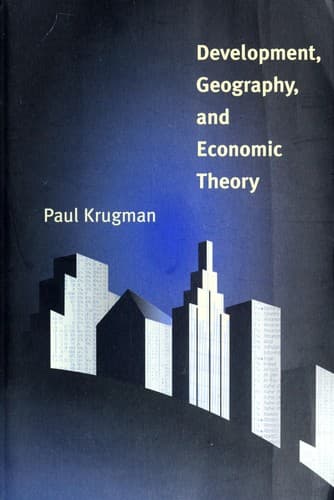
Development, Geography, and Economic Theory
by Paul Krugman
Paul Krugman argues that the unwillingness of mainstream economists to think about what they could not formalize led them to ignore ideas that turn out, in retrospect, to have been very good ones.
Krugman examines the course of economic geography and development theory to shed light on the nature of economic inquiry. He traces how development theory lost its huge initial influence and virtually disappeared from economic discourse after it became clear that many of the theory's main insights could not be clearly modeled.
Economic geography seems to have fared even worse, as economists shied away from grappling with questions about space - such as the size, location, or even existence of…
Read the full description
Paul Krugman argues that the unwillingness of mainstream economists to think about what they could not formalize led them to ignore ideas that turn out, in retrospect, to have been very good ones.
Krugman examines the course of economic geography and development theory to shed light on the nature of economic inquiry. He traces how development theory lost its huge initial influence and virtually disappeared from economic discourse after it became clear that many of the theory's main insights could not be clearly modeled.
Economic geography seems to have fared even worse, as economists shied away from grappling with questions about space - such as the size, location, or even existence of…
Paul Krugman argues that the unwillingness of mainstream economists to think about what they could not formalize led them to ignore ideas that turn out, in retrospect, to have been very good ones.
Krugman examines the course of economic geography and development theory to shed light on the nature of economic inquiry. He traces how development theory lost its huge initial influence and virtually disappeared from economic discourse after it became clear that many of the theory's main insights could not be clearly modeled.
Economic geography seems to have fared even worse, as economists shied away from grappling with questions about space - such as the size, location, or even existence of cities - because the "terrain was seen as unsuitable for the tools at hand." Krugman's book, however, is not a call to abandon economic modeling. He concludes with a reminder of why insisting on the use of models may be right, even when these sometimes lead economists to overlook good ideas.
Your rating & review
Rate this book
Unrated
Ratings & reviews
No ratings here yet. Read it? Leave your mark in the margin.
Editions
Gathering editions from Open Library…
Something tucked inside your copy?
A pressed flower, a ticket stub, an inscription on the flyleaf. Photograph it for Found in Books.
Send your copy travelling
Print a numbered bookplate, pass the book on, and follow where it goes next.
About Development, Geography, and Economic Theory
A few practical answers before choosing a copy.
Bibliographic source: Open Library- Who wrote Development, Geography, and Economic Theory?
Development, Geography, and Economic Theory is by Paul Krugman. The catalogue records its first publication in 1995. A later edition may have a different publication date on its copyright page.
- How long is Development, Geography, and Economic Theory?

