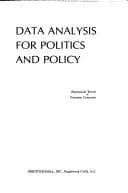
Data Analysis for Politics and Policy
by Edward Tufte
Abstract: Introduction to data analysis; Predictions and projections: some issues of research design; Two-variable linear regression; Multiple regression.
Review:
"Journal of the American Statistical Association, September 1976"
Data Analysis for Politics and Policy,
Edward R. Tufte. Englewood Cliffs, New Jersey : Prentice-Hall,
1974. x + 179 pp.
"Edward R. Tufte's book Data Analysis for Politics and Policy is, quite simply, excellent. The aims of the author in the writing of this book is "is to present fundamental material not found in statistics books, and in particular, to show techniques of quantitative analysis in action on problems of politics and policy" (p. ix). To…
Read the full description
Abstract: Introduction to data analysis; Predictions and projections: some issues of research design; Two-variable linear regression; Multiple regression.
Review:
"Journal of the American Statistical Association, September 1976"
Data Analysis for Politics and Policy,
Edward R. Tufte. Englewood Cliffs, New Jersey : Prentice-Hall,
1974. x + 179 pp.
"Edward R. Tufte's book Data Analysis for Politics and Policy is, quite simply, excellent. The aims of the author in the writing of this book is "is to present fundamental material not found in statistics books, and in particular, to show techniques of quantitative analysis in action on problems of politics and policy" (p. ix). To…
Abstract: Introduction to data analysis; Predictions and projections: some issues of research design; Two-variable linear regression; Multiple regression.
Review:
"Journal of the American Statistical Association, September 1976"
Data Analysis for Politics and Policy,
Edward R. Tufte. Englewood Cliffs, New Jersey : Prentice-Hall,
1974. x + 179 pp.
"Edward R. Tufte's book Data Analysis for Politics and Policy is, quite simply, excellent. The aims of the author in the writing of this book is "is to present fundamental material not found in statistics books, and in particular, to show techniques of quantitative analysis in action on problems of politics and policy" (p. ix). To achieve this end, Tufte considers a narrow range of important topics in statistical analysis, primarily dealing with problems Of prediction (including a good discussion of the concept of causation) and the relationships among variables through simple and multiple regression.
Most of the ideas discussed are presented in several detailed examples.
For example, much of the first chapter explores the relationship, causal or otherwise, between mandatory motor vehicle inspection and deaths due to automobile accidents. This example begins with an interesting problem and then suggests a collection Of data to study it (i.e., data on 49 states for the years 1966—68). Problems, such as units of measurements, causation vs. association, and the types Of inference possible from such data, naturally arise.
Your rating & review
Rate this book
Unrated
Ratings & reviews
No ratings here yet. Read it? Leave your mark in the margin.
Editions
Gathering editions from Open Library…
Something tucked inside your copy?
A pressed flower, a ticket stub, an inscription on the flyleaf. Photograph it for Found in Books.
Send your copy travelling
Print a numbered bookplate, pass the book on, and follow where it goes next.
About Data Analysis for Politics and Policy
A few practical answers before choosing a copy.
Bibliographic source: Open Library- Who wrote Data Analysis for Politics and Policy?
Data Analysis for Politics and Policy is by Edward Tufte. The catalogue records its first publication in 1974. A later edition may have a different publication date on its copyright page.
- How long is Data Analysis for Politics and Policy?
