How to write a wanted-book request that finds the right copy
Write a clear wanted-book request with templates for reading, matching and collecting copies. Separate essentials, condition limits and your delivered budget.
By Creasy Spines · · Sources and method below
The short answer
Name the title and author, explain what kind of copy you need, and separate essential requirements from preferences. Add the edition or ISBN where relevant, specific condition limits, and a budget that names the currency and whether delivery is included. Ask for evidence of uncertain details before deciding that a listing is a match.
Choose the job before choosing the filters
A wanted-book request is easier to answer when it explains what would make a copy useful to you. Someone replacing a lost reading copy may accept several editions. Someone completing a matching set may need a particular publisher and binding. A collector may need a precise printing and its correct jacket. Start with one sentence describing your purpose, then keep only the requirements that serve it.
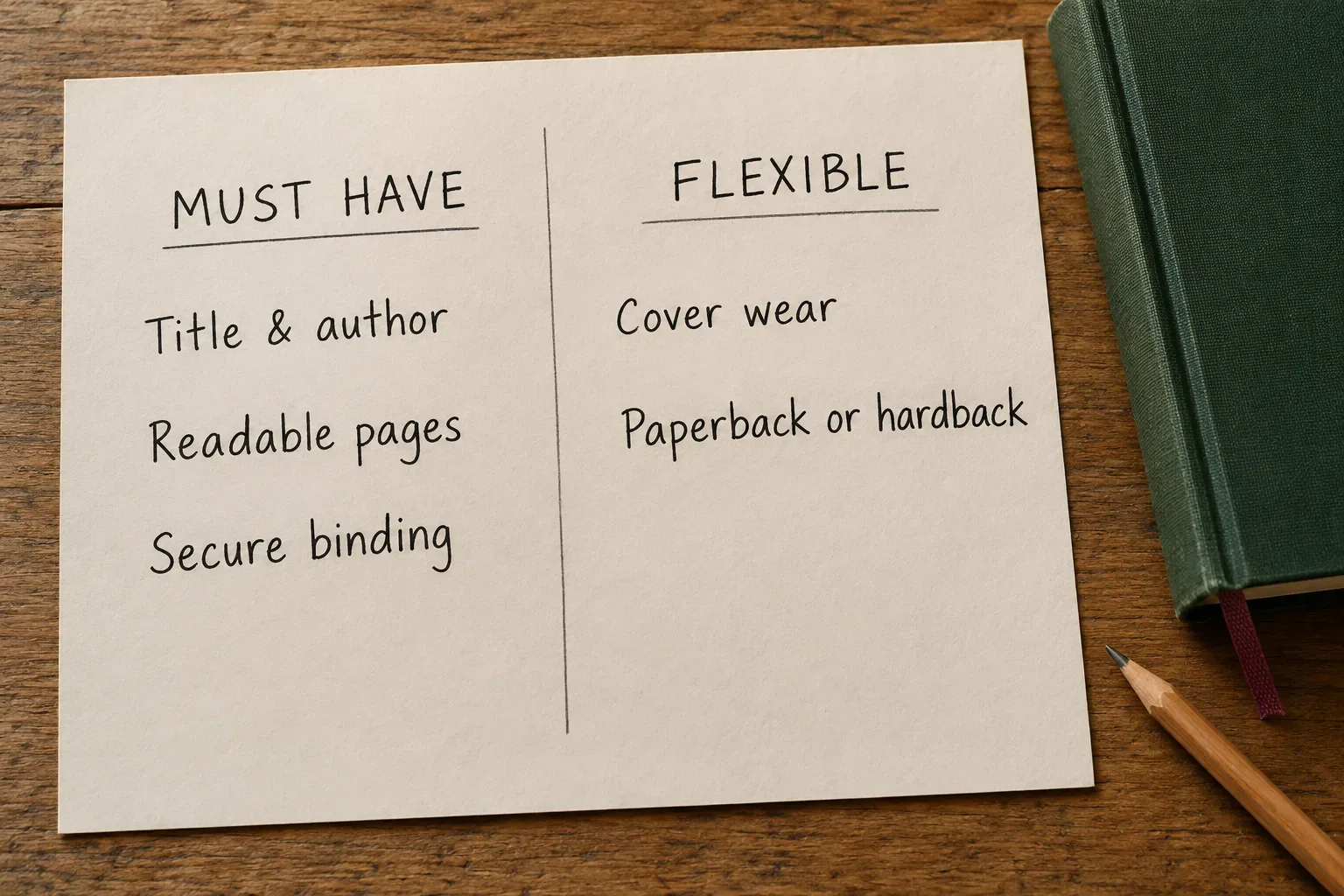
Make two short lists: essential and flexible. For an ordinary reading copy, complete readable text and a sound binding may be essential while cover wear is acceptable. For a matching set, the binding may move into the essential column. These are suggested examples, not universal grading rules. A condition label should still be checked against the seller’s description of the actual copy.
Record the details that separate a match from a near miss
Write the title and author in full. Add the language, translator, volume number or required contents when those affect the choice. If you need a particular edition, record its publisher, format and ISBN where available. The International ISBN Agency’s guidance requires separate ISBNs for different formats and a change of publisher, so a title-only match does not settle those details.
Describe condition in terms a seller can check. “No highlighting in the text” or “all listed maps present” is clearer than “nice condition”. State your budget with its currency and clarify whether it includes delivery. If you have a deadline, say when the book must arrive rather than assuming a seller’s dispatch date is the arrival date.
- Keep unknown edition details marked as unknown until you can verify them.
- Separate a required dust jacket from a preference for an attractive cover.
- Mention whether ownership inscriptions, library markings or repaired bindings would change your decision.
- Keep photographs or a source record of the edition you are trying to match in your own notes.
Three request templates you can adapt
Replace the bracketed fields below with your own details and remove anything irrelevant. These are example requests, not messages already sent to a seller or claims about stock availability. Use the short essentials when setting a search, and retain the full wording for checking a particular offer.
Reading copy: “I’m looking for [title] by [author], in [language / required translation]. I need complete, readable text and a secure binding. [Describe acceptable markings or wear]. Paperback or hardback is fine. My budget is [amount and currency, including or excluding delivery] to [destination]. Please flag missing pages, heavy annotation or loose leaves.”
Matching copy: “I need [title and volume] by [author] to match [publisher / series / format]. The ISBN I have is [ISBN, if confirmed]. [Translator, binding or other identifying detail] is essential; [acceptable differences] are flexible. Could you show the title and copyright pages and the relevant binding detail before I decide?”
Collecting copy: “I’m seeking [title] by [author], [specific edition or printing sought]. I need [required jacket and copy-specific features]. Please provide photographs of the relevant edition evidence and describe repairs, inscriptions and defects separately for the book and jacket. My budget is [amount and currency, delivery basis]. I will check the bibliographic evidence before agreeing that the copy matches.”
Turn the request into a Hunt List search
Creasy Spines’ Hunt List lets signed-in readers search the catalogue and set a price ceiling, minimum condition and available must-have filters. Use only the filters that correspond to your actual essentials. Keep the longer request in your own notes so that details a filter cannot express are not lost.
A surfaced listing is a candidate to inspect. Open the current offer and check edition, condition, delivery and availability against your request. A match notification does not guarantee that the copy is still for sale or that a first-edition or signature claim is authenticated. Use Edition Detective for copyright-page clues and specialist evidence when the collecting decision requires it.
Revise the request using the mismatches you see
If plausible results keep failing the same check, make that requirement more explicit. If every near match differs only in something you do not care about, relax that preference rather than dropping an essential such as required contents or readability. This is a suggested review method, not a promise that broadening a search will find stock.
Keep the search current when your plans change. Pause an unnecessary hunt or mark a book as found using the available controls. Before contacting a bookseller, ask whether they accept wanted lists and follow their preferred format; setting a Hunt List search is not the same as sending your request to an individual shop.
Sources: 1
Sources & checking notes
These sources support the factual explanations. Practical examples and suggested methods are editorial guidance; they are not a claim of a personal visit, appraisal or independently tested result.
- Creasy Spines: Hunt List features and matching limitsSource checked 2026-11-01
- AbeBooks: a guide to used book conditionsSource checked 2026-11-01
- International ISBN Agency: assigning ISBNs to editions and formatsSource checked 2026-11-01
- Creasy Spines: Edition Detective features and limitsSource checked 2026-11-01
A few more useful answers
- Do I need an ISBN for every wanted-book request?
No. A title, author and clear description can start a request, especially when the edition is not important or no ISBN is available. Include a verified ISBN when it helps distinguish the format or edition you need, and still check the actual copy.
- Should I select every available condition or edition filter?
Use the filters that express genuine requirements. Selecting a first printing, signature or hardback merely because the option exists can exclude a reading copy that would suit you. Keep preferences separate from essentials.
- How should I describe the maximum price?
Name the amount and currency, and state whether delivery is included. Compare the final cost of the particular offer before buying; a search ceiling is not a guarantee of the delivered total.
- Does a Hunt List match confirm the book is available?
No. Open the current listing and check availability, edition, condition and delivery. Seller stock and prices can change, and a matching title does not confirm every detail of a particular copy.