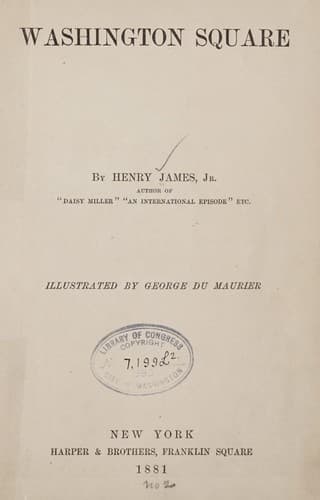
Washington Square
by Henry James
Open Library readers: 3.33 / 5 from 6 ratings. Separate from ratings here.Catalogue checked 2026-11-16.
With a new afterword by Michael CunninghamWhat Catherine Sloper lacks in brains and beauty, she makes up for by being "very good." The handsome Morris Townsend would do anything to win her hand-even if it means pretending that he loves the homely ingenue, and cares nothing for her opulent wealth.
Throughout time, the women of the world always had limited rights when it came to anything. You could almost say they were being discriminated just because of their gender. However, this all changed because of one woman in particular: Deborah Sampson. Deborah Sampson was the first known American woman to impersonate a man in order to join the army and take part in combat. She was born in Plympton…
Read the full description
With a new afterword by Michael CunninghamWhat Catherine Sloper lacks in brains and beauty, she makes up for by being "very good." The handsome Morris Townsend would do anything to win her hand-even if it means pretending that he loves the homely ingenue, and cares nothing for her opulent wealth.
Throughout time, the women of the world always had limited rights when it came to anything. You could almost say they were being discriminated just because of their gender. However, this all changed because of one woman in particular: Deborah Sampson. Deborah Sampson was the first known American woman to impersonate a man in order to join the army and take part in combat. She was born in Plympton…
With a new afterword by Michael CunninghamWhat Catherine Sloper lacks in brains and beauty, she makes up for by being "very good." The handsome Morris Townsend would do anything to win her hand-even if it means pretending that he loves the homely ingenue, and cares nothing for her opulent wealth.
Throughout time, the women of the world always had limited rights when it came to anything. You could almost say they were being discriminated just because of their gender. However, this all changed because of one woman in particular: Deborah Sampson. Deborah Sampson was the first known American woman to impersonate a man in order to join the army and take part in combat. She was born in Plympton, Massachusetts on December 17, 1760 as the oldest of three daughters and three sons of Jonathan and Deborah Sampson. Her family descended from one of the original colonists, Priscilla Mullins Alden, who was John Alden’s wife and later immortalized in Longfellow's poem, "The Courtship of Miles Standish." ((Quote)…Near him was seated John Alden, his friend, and household companion…) Deborah's youth was spent in poverty. Her father abandoned the family we she was young and went off to sea. Her mother was of poor health and could not support the children, so she sent them off to live with various neighbors and relatives. At the young age of around 8-10, Deborah Sampson became an indentured servant in the household of Jeremiah and Susannah Thomas in Middleborough, Massachusetts. For ten years she helped with the housework and worked in the field. All the hard labor developed her physical strength. With the Thomas family, she gained a tremendous amount of knowledge. She often learned from the books that were lying around the house while she worked. Deborah became very interested in politics. In winter, when there wasn't as much farm work to be done, Jeremiah allowed her to attend school. When she turned 18, she could not serve the Thomas household. But she lived with them for 2 more years, and worked as a weaver and she was hired as a teacher in a Middleborough public school. On May 20, 1782, when she was twenty-one, Deborah Sampson enlisted in the Fourth Massachusetts Regiment of the Continental Army at Bellingham as a man named Robert Shurtleff (also listed as Shirtliff or Shirtlieff). On May 23rd, she was assembled into service at Worcester. Being 5 foot 7 inches tall, she looked tall for a woman with a male physique. Other soldiers teased her about not having to shave, but they assumed that this "boy" was just too young to grow facial hair. She performed her duties as well as any other man, in countless battles. Back home, rumors started to spread about her activities and she was excommunicated from the First Baptist Church of Middleborough, Massachusetts, because of a strong suspicion that she was "dressing in man's clothes and enlisting as a Soldier in the Army." At the time of her excommunication, her regiment had already left Massachusetts. Sampson was sent with her regiment to West Point, New York, where she was wounded in the thigh by a musket ball and cut in the forehead in a battle near Tarrytown. Knowing that people would know the truth if she got medical attention, she only got her forehead treated and tended her own wounds by removing the musket ball with a penknife and sewing the wound herself so that her gender would not be discovered. As a result, her leg never healed properly. However, in 1783, when she was later hospitalized for fever in Philadelphia, the physician Barnabas Binney attending her discovered that she was a woman and he took her to his home where his wife and daughters took care of Deborah. When the Treaty of Paris was signed in September 1783, Dr. Binney sent Deborah to George Washington with a note. Although her secret was found out, George Washington never said anything. Sampson was honorably discharged from the army at West Point on October 25, 1783 by General Henry Knox with money to cover her travel fee. Deborah Sampson returned home, married a farmer named Benjamin Gannett, and had three children: Earl, Mary and Patience. She also taught at a nearby school. In 1802, Sampson traveled throughout New England and New York giving lectures on her experiences in the military. During her lectures, she wore her military uniform. About nine years after her discharge from the army, she was awarded a pension from the state of Massachusetts in the amount of thirty-four pounds in a lump payment. But even with that kind of money, her financial problem continued on. She would often borrow money from friends and relatives, primarily from her friend Paul Revere. She did not get any pension from the army like the rest of the soldiers even though she had been honorably discharged, simply because she was a woman. After Paul Revere sent a letter to Congress on her behalf in 1804, she started receiving a U.S. pension in the amount of four dollars per month. In 1809, Deborah Sampson finally sent a petition to the Congress requesting that her pension as an invalid soldier would be from the start of 1783, to the time she was discharged. This would mean that her cumulative pension would amount to $960 which would give her $48 per month. This time, the Congress approved her request and granted her $76 per month as pension instead. With this money, she was able to pay off all her debts and take better care of her family. Deborah Sampson Gannett died April 29, 1827 in Sharon, Massachusetts, at age sixty-six. Her children were awarded compensation by a special act of Congress "for the relief of the heirs of Deborah Gannett, a soldier of the Revolution, deceased." She is now buried in the Rockridge Cemetery in Sharon, Massachusetts. Her actions of impersonating a man truly touched many people, showing that women can do anything just as good as men can and also telling women to pursue their dreams, no matter what others say. She may have been a significant person in history, but she changed the world’s way of thinking. She inspired women to gain their rights.
Your rating & review
Rate this book
Unrated
Ratings & reviews
No ratings here yet. Read it? Leave your mark in the margin.
Editions
Gathering editions from Open Library…
Something tucked inside your copy?
A pressed flower, a ticket stub, an inscription on the flyleaf. Photograph it for Found in Books.
Send your copy travelling
Print a numbered bookplate, pass the book on, and follow where it goes next.
About Washington Square
A few practical answers before choosing a copy.
Bibliographic source: Open Library- Who wrote Washington Square?
Washington Square is by Henry James. The catalogue records its first publication in 1880. A later edition may have a different publication date on its copyright page.
- How long is Washington Square?
The catalogue records 214 pages for a representative edition. Pagination varies with the publisher, format, type size and translation, so check the edition you intend to read.


