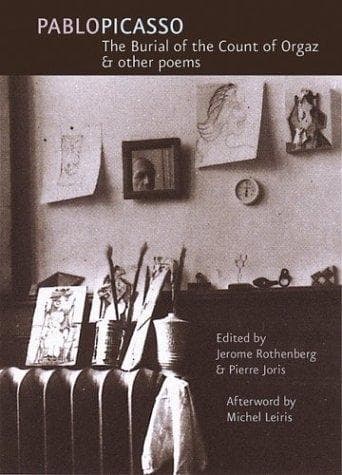
The Burial of the Count of Orgaz & Other Poems
"Pablo Picasso may be the most famous and influential artist of the twentieth century. What few know is that in 1935, at age 54, Picasso stopped painting, and for a time devoted himself entirely to poetry. Even after eventually resuming his visual work, Picasso continued to write, in a characteristic torrent, until 1959 - leaving a body of poems that Andre Breton praised as, "an intimate journal, both of the feelings and the senses, such as has never been kept before." Near the end of his life, Picasso himself would tell a friend that, "long after his death his writing would gain recognition and encyclopedias would say: 'Picasso, Pablo Ruiz - Spanish poet who dabbled in painting, drawing…
Read the full description
"Pablo Picasso may be the most famous and influential artist of the twentieth century. What few know is that in 1935, at age 54, Picasso stopped painting, and for a time devoted himself entirely to poetry. Even after eventually resuming his visual work, Picasso continued to write, in a characteristic torrent, until 1959 - leaving a body of poems that Andre Breton praised as, "an intimate journal, both of the feelings and the senses, such as has never been kept before." Near the end of his life, Picasso himself would tell a friend that, "long after his death his writing would gain recognition and encyclopedias would say: 'Picasso, Pablo Ruiz - Spanish poet who dabbled in painting, drawing…
"Pablo Picasso may be the most famous and influential artist of the twentieth century. What few know is that in 1935, at age 54, Picasso stopped painting, and for a time devoted himself entirely to poetry. Even after eventually resuming his visual work, Picasso continued to write, in a characteristic torrent, until 1959 - leaving a body of poems that Andre Breton praised as, "an intimate journal, both of the feelings and the senses, such as has never been kept before." Near the end of his life, Picasso himself would tell a friend that, "long after his death his writing would gain recognition and encyclopedias would say: 'Picasso, Pablo Ruiz - Spanish poet who dabbled in painting, drawing and sculpture.'"" "Jerome Rothenberg and Pierre Joris have overseen a project to translate the majority of this writing into English for the first time. Working from Picasso's Spanish and French (he wrote in both languages), they have enlisted the help of over a dozen colleagues in order to mark, as they note in their introduction, "Picasso's entry into our own time." Picasso's poems are as protean, erotic, scatological, and experimental as his visual art - yet they arrive as a twenty-first century surprise, even for many devotees."—BOOK JACKET.
Your rating & review
Rate this book
Unrated
Ratings & reviews
No ratings here yet. Read it? Leave your mark in the margin.
Editions
Gathering editions from Open Library…
Something tucked inside your copy?
A pressed flower, a ticket stub, an inscription on the flyleaf. Photograph it for Found in Books.
Send your copy travelling
Print a numbered bookplate, pass the book on, and follow where it goes next.
About The Burial of the Count of Orgaz & Other Poems
A few practical answers before choosing a copy.
Bibliographic source: Open Library- Who wrote The Burial of the Count of Orgaz & Other Poems?
The Burial of the Count of Orgaz & Other Poems is by Pablo Picasso. The catalogue records its first publication in 2004. A later edition may have a different publication date on its copyright page.
