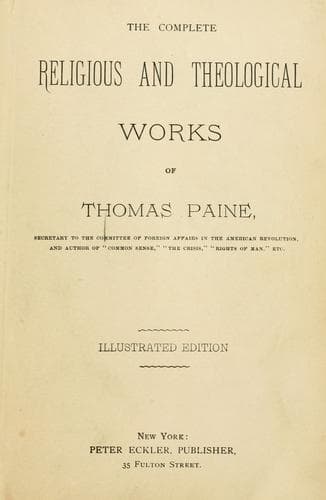
The Age of Reason
Being an Investigation of True and Fabulous Theology
by Thomas Paine
Open Library readers: 4.67 / 5 from 3 ratings. Separate from ratings here.Catalogue checked 2026-11-16.
Thomas Paine who was a dynamic philosophical presence in the American Revolution of 1776 wrote his last book in 1795 on an investigation and commentary of organized religion with a focus on Christianity. Paine said that his "religious duties" included doing justice, loving benevolence, and attempting to make others happy. He called himself a deist which is a person who believes in the existence of a God based on the evidence of reason and nature but not on supernatural revelation. In this book he outlines deism as a rational religious belief and offers an analysis of the Bible based on textual content. He makes comparisons of the internal arguments of the Old and New Testaments by…
Read the full description
Thomas Paine who was a dynamic philosophical presence in the American Revolution of 1776 wrote his last book in 1795 on an investigation and commentary of organized religion with a focus on Christianity. Paine said that his "religious duties" included doing justice, loving benevolence, and attempting to make others happy. He called himself a deist which is a person who believes in the existence of a God based on the evidence of reason and nature but not on supernatural revelation. In this book he outlines deism as a rational religious belief and offers an analysis of the Bible based on textual content. He makes comparisons of the internal arguments of the Old and New Testaments by…
Thomas Paine who was a dynamic philosophical presence in the American Revolution of 1776 wrote his last book in 1795 on an investigation and commentary of organized religion with a focus on Christianity. Paine said that his "religious duties" included doing justice, loving benevolence, and attempting to make others happy. He called himself a deist which is a person who believes in the existence of a God based on the evidence of reason and nature but not on supernatural revelation. In this book he outlines deism as a rational religious belief and offers an analysis of the Bible based on textual content. He makes comparisons of the internal arguments of the Old and New Testaments by explaining, for example, inconsistencies of the biographic accounts in the four gospels. Paine suggests that since they were written separate of each other their basis is no better than hearsay. Because the United States convicted Paine of seditious libel in 1792, he escaped to France where he was selected to be a member of its National Convention. But there he conflicted with Robespierre, and while awaiting his arrest he wrote the first part of "The Age of Reason." Afterwards he was confined in Luxembourg and wrote the second half of the book. The work was published in 1795 and serves as a criticism of established religion from the point of view of the 18th century deists. Paine's clear and concise understanding of the development of the Christian religion from its pagan origins is especially significant when the reader examines the interconnecting references and implications of superstition and fallacy that are still involved in any ceremonial aspect. And, finally, Thomas Paine explains the answer to any confrontation best of all: "The most formidable weapon against errors of every kind is Reason."Please Note: This book is easy to read in true text, not scanned images that can sometimes be difficult to decipher. The Microsoft eBook has a contents page linked to the chapter headings for easy navigation. The Adobe eBook has bookmarks at chapter headings and is printable up to two full copies per year. Both versions are text searchable.
Your rating & review
Rate this book
Unrated
Ratings & reviews
No ratings here yet. Read it? Leave your mark in the margin.
Editions
Gathering editions from Open Library…
Something tucked inside your copy?
A pressed flower, a ticket stub, an inscription on the flyleaf. Photograph it for Found in Books.
Send your copy travelling
Print a numbered bookplate, pass the book on, and follow where it goes next.
About The Age of Reason
A few practical answers before choosing a copy.
Bibliographic source: Open Library- Who wrote The Age of Reason?
The Age of Reason is by Thomas Paine. The catalogue records its first publication in 1794. A later edition may have a different publication date on its copyright page.
- How long is The Age of Reason?
The catalogue records 155 pages for a representative edition. Pagination varies with the publisher, format, type size and translation, so check the edition you intend to read.


