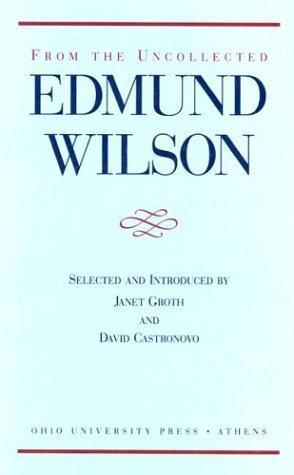
From the uncollected Edmund Wilson
Many of Wilson's writings have been anthologized. But there is another body of work - over fifty fine essays on aspects of contemporary literature and ideas - that have been scattered in a variety of magazines, including The New Yorker, The New Republic, Vanity Fair, and The Nation.
The editors, who recognize Wilson (1895-1972) as one of America's greatest men of letters of the twentieth century, also view his writing as a powerful antidote to late twentieth-century trends and fads and have collected his pieces here in the conviction that Wilson's writing is a permanently important model. Now a new generation of readers - as well as his loyal followers - will have access to this rich…
Read the full description
Many of Wilson's writings have been anthologized. But there is another body of work - over fifty fine essays on aspects of contemporary literature and ideas - that have been scattered in a variety of magazines, including The New Yorker, The New Republic, Vanity Fair, and The Nation.
The editors, who recognize Wilson (1895-1972) as one of America's greatest men of letters of the twentieth century, also view his writing as a powerful antidote to late twentieth-century trends and fads and have collected his pieces here in the conviction that Wilson's writing is a permanently important model. Now a new generation of readers - as well as his loyal followers - will have access to this rich…
Many of Wilson's writings have been anthologized. But there is another body of work - over fifty fine essays on aspects of contemporary literature and ideas - that have been scattered in a variety of magazines, including The New Yorker, The New Republic, Vanity Fair, and The Nation.
The editors, who recognize Wilson (1895-1972) as one of America's greatest men of letters of the twentieth century, also view his writing as a powerful antidote to late twentieth-century trends and fads and have collected his pieces here in the conviction that Wilson's writing is a permanently important model. Now a new generation of readers - as well as his loyal followers - will have access to this rich literary heritage in a single volume.
. The collection is organized chronologically and leads the reader through the journeyman writing at Hill School and Princeton, the essays on literary modernism and contemporary culture written in the 1920s, the socially-focused critiques of the 1930s, and the diverse assortment of book reviews of the late period. Across this full range of moods and literary styles, Wilson is a powerful spokesman for writers and a guardian of imagination and decency for the informed citizen.
Your rating & review
Rate this book
Unrated
Ratings & reviews
No ratings here yet. Read it? Leave your mark in the margin.
Editions
Gathering editions from Open Library…
Something tucked inside your copy?
A pressed flower, a ticket stub, an inscription on the flyleaf. Photograph it for Found in Books.
Send your copy travelling
Print a numbered bookplate, pass the book on, and follow where it goes next.
About From the uncollected Edmund Wilson
A few practical answers before choosing a copy.
Bibliographic source: Open Library- Who wrote From the uncollected Edmund Wilson?
From the uncollected Edmund Wilson is by Edmund Wilson. The catalogue records its first publication in 1995. A later edition may have a different publication date on its copyright page.
- How long is From the uncollected Edmund Wilson?
