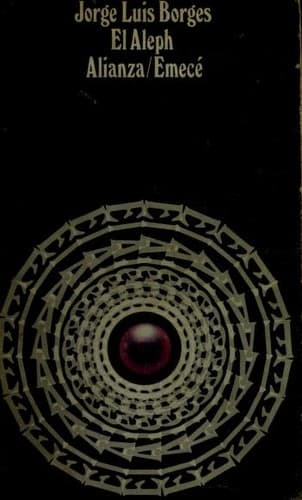
El Aleph
Open Library readers: 4.27 / 5 from 15 ratings. Separate from ratings here.Catalogue checked 2026-11-16.
In Borges' story, the Aleph is a point in space that contains all other points. Anyone who gazes into it can see everything in the universe from every angle simultaneously, without distortion, overlapping, or confusion. The story traces the theme of infinity found in several of Borges' other works, such as "The Book of Sand". As in many of Borges' short stories, the protagonist is a fictionalized version of the author. At the beginning of the story, he is mourning the recent death of a woman whom he loved, named Beatriz Viterbo, and resolves to stop by the house of her family to pay his respects. Over time, he comes to know her first cousin, Carlos Argentino Daneri, a mediocre poet with a…
Read the full description
In Borges' story, the Aleph is a point in space that contains all other points. Anyone who gazes into it can see everything in the universe from every angle simultaneously, without distortion, overlapping, or confusion. The story traces the theme of infinity found in several of Borges' other works, such as "The Book of Sand". As in many of Borges' short stories, the protagonist is a fictionalized version of the author. At the beginning of the story, he is mourning the recent death of a woman whom he loved, named Beatriz Viterbo, and resolves to stop by the house of her family to pay his respects. Over time, he comes to know her first cousin, Carlos Argentino Daneri, a mediocre poet with a…
In Borges' story, the Aleph is a point in space that contains all other points. Anyone who gazes into it can see everything in the universe from every angle simultaneously, without distortion, overlapping, or confusion. The story traces the theme of infinity found in several of Borges' other works, such as "The Book of Sand". As in many of Borges' short stories, the protagonist is a fictionalized version of the author. At the beginning of the story, he is mourning the recent death of a woman whom he loved, named Beatriz Viterbo, and resolves to stop by the house of her family to pay his respects. Over time, he comes to know her first cousin, Carlos Argentino Daneri, a mediocre poet with a vastly exaggerated view of his own talent who has made it his lifelong quest to write an epic poem that describes every single location on the planet in excruciatingly fine detail. Later in the story, a business on the same street attempts to tear down Daneri's house in the course of its expansion. Daneri becomes enraged, explaining to the narrator that he must keep the house in order to finish his poem, because the cellar contains an Aleph which he is using to write the poem. Though by now he believes Daneri to be quite insane, the narrator proposes without waiting for an answer to come to the house and see the Aleph for himself. Left alone in the darkness of the cellar, the narrator begins to fear that Daneri is conspiring to kill him, and then he sees the Aleph for himself: "On the back part of the step, toward the right, I saw a small iridescent sphere of almost unbearable brilliance. At first I thought it was revolving; then I realised that this movement was an illusion created by the dizzying world it bounded. The Aleph's diameter was probably little more than an inch, but all space was there, actual and undiminished. Each thing (a mirror's face, let us say) was infinite things, since I distinctly saw it from every angle of the universe. I saw the teeming sea; I saw daybreak and nightfall; I saw the multitudes of America; I saw a silvery cobweb in the center of a black pyramid; I saw a splintered labyrinth (it was London); I saw, close up, unending eyes watching themselves in me as in a mirror; I saw all the mirrors on earth and none of them reflected me; I saw in a backyard of Soler Street the same tiles that thirty years before I'd seen in the entrance of a house in Fray Bentos; I saw bunches of grapes, snow, tobacco, lodes of metal, steam; I saw convex equatorial deserts and each one of their grains of sand..." Though staggered by the experience of seeing the Aleph, the narrator pretends to have seen nothing in order to get revenge on Daneri, whom he dislikes, by giving Daneri a reason to doubt his own sanity. The narrator tells Daneri that he has lived too long amongst the noise and bustle of the city and spent too much time in the dark and enclosed space of his cellar, and assures him that what he truly needs are the wide open spaces and fresh air of the countryside, and these will provide him the true peace of mind that he needs to complete his poem. He then takes his leave of Daneri and exits the house. In a postscript to the story, Borges explains that Daneri's house was ultimately demolished, but that Daneri himself won second place for the Argentine National Prize for Literature. He also states his belief that the Aleph in Daneri's house was not the only one that exists, based on a report he has discovered, written by "Captain Burton" (Richard Francis Burton) when he was British consul in Brazil, describing the Mosque of Amr in Cairo, within which there is said to be a stone pillar that contains the entire universe; although this Aleph cannot be seen, it is said that those who put their ear to the pillar can hear a continuous hum that symbolises all the concurrent noises of the universe heard at any given time. - Wikipedia.
Your rating & review
Rate this book
Unrated
Ratings & reviews
No ratings here yet. Read it? Leave your mark in the margin.
Editions
Gathering editions from Open Library…
Something tucked inside your copy?
A pressed flower, a ticket stub, an inscription on the flyleaf. Photograph it for Found in Books.
Send your copy travelling
Print a numbered bookplate, pass the book on, and follow where it goes next.
- Who wrote El Aleph?
El Aleph is by Jorge Luis Borges. The catalogue records its first publication in 1949. A later edition may have a different publication date on its copyright page.
- How long is El Aleph?
The catalogue records 184 pages for a representative edition. Pagination varies with the publisher, format, type size and translation, so check the edition you intend to read.


