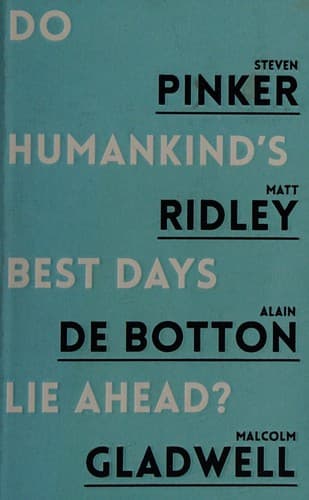
Do Humankind's Best Days Lie Ahead?
by Steven Pinker, Malcolm Gladwell, Matt Ridley and Alain de Botton
Is humanity approaching a Golden Age, driven by technology and ever-closer global networks? Or is the notion of progress an illusion born in the West? From the Enlightenment onwards, the West has had an enduring belief that through the evolution of institutions, innovations, and ideas, the human condition is improving. This process is supposedly accelerating as new technologies, individual freedoms, and the spread of global norms empower individuals and societies around the world. But is progress inevitable? Its critics argue that human civilization has become different, not better, over the last two and a half centuries. What is seen as a breakthrough or innovation in one period becomes a…
Read the full description
Is humanity approaching a Golden Age, driven by technology and ever-closer global networks? Or is the notion of progress an illusion born in the West? From the Enlightenment onwards, the West has had an enduring belief that through the evolution of institutions, innovations, and ideas, the human condition is improving. This process is supposedly accelerating as new technologies, individual freedoms, and the spread of global norms empower individuals and societies around the world. But is progress inevitable? Its critics argue that human civilization has become different, not better, over the last two and a half centuries. What is seen as a breakthrough or innovation in one period becomes a…
Is humanity approaching a Golden Age, driven by technology and ever-closer global networks? Or is the notion of progress an illusion born in the West? From the Enlightenment onwards, the West has had an enduring belief that through the evolution of institutions, innovations, and ideas, the human condition is improving. This process is supposedly accelerating as new technologies, individual freedoms, and the spread of global norms empower individuals and societies around the world. But is progress inevitable? Its critics argue that human civilization has become different, not better, over the last two and a half centuries. What is seen as a breakthrough or innovation in one period becomes a setback or limitation in another. In short, progress is an ideology not a fact; a way of thinking about the world as opposed to a description of reality. So is the cup half full or half empty? As part of the Munk Debates series, held in Toronto biannually, pioneering cognitive scientist Steven Pinker and bestselling author Matt Ridley squared off against noted philosopher Alain de Botton and bestselling author Malcolm Gladwell, giving us an entertaining and thought-provoking face-off between four of the world's most renowned thinkers—Publisher's description.
Your rating & review
Rate this book
Unrated
Ratings & reviews
No ratings here yet. Read it? Leave your mark in the margin.
Editions
Gathering editions from Open Library…
Something tucked inside your copy?
A pressed flower, a ticket stub, an inscription on the flyleaf. Photograph it for Found in Books.
Send your copy travelling
Print a numbered bookplate, pass the book on, and follow where it goes next.
About Do Humankind's Best Days Lie Ahead?
A few practical answers before choosing a copy.
Bibliographic source: Open Library- Who wrote Do Humankind's Best Days Lie Ahead??
Do Humankind's Best Days Lie Ahead? is by Steven Pinker, Matt Ridley, Alain de Botton, Malcolm Gladwell. The catalogue records its first publication in 2016. A later edition may have a different publication date on its copyright page.

