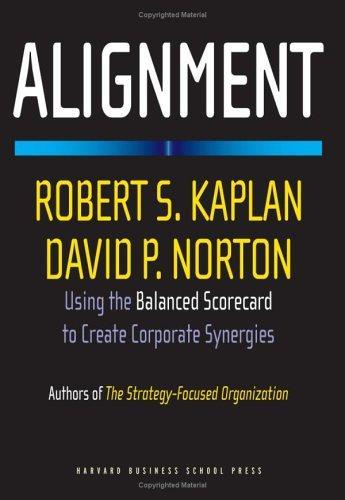
Alignment
"Most organizations contain multiple business and support units, each led by highly trained, experienced executives and staffed by talented employees. But too often, different units fail to coordinate: they work at cross-purposes and have conflicting goals. Results? Performance-sapping disagreements, lost opportunities, wasted resources - and a corporation whose value amounts to less than the sum of its parts." "Robert S. Kaplan and David P. Norton explain how to correct such organizational misalignment - not only within a company but between the firm and its board of directors, investors, customers, and suppliers."
"The authors maintain that the responsibility for organizational alignment…
Read the full description
"Most organizations contain multiple business and support units, each led by highly trained, experienced executives and staffed by talented employees. But too often, different units fail to coordinate: they work at cross-purposes and have conflicting goals. Results? Performance-sapping disagreements, lost opportunities, wasted resources - and a corporation whose value amounts to less than the sum of its parts." "Robert S. Kaplan and David P. Norton explain how to correct such organizational misalignment - not only within a company but between the firm and its board of directors, investors, customers, and suppliers."
"The authors maintain that the responsibility for organizational alignment…
"Most organizations contain multiple business and support units, each led by highly trained, experienced executives and staffed by talented employees. But too often, different units fail to coordinate: they work at cross-purposes and have conflicting goals. Results? Performance-sapping disagreements, lost opportunities, wasted resources - and a corporation whose value amounts to less than the sum of its parts." "Robert S. Kaplan and David P. Norton explain how to correct such organizational misalignment - not only within a company but between the firm and its board of directors, investors, customers, and suppliers."
"The authors maintain that the responsibility for organizational alignment lies with corporate headquarters. They show how top executives can build a corporate-level strategy map and scorecard that graphically depict their company's "enterprise value proposition"—How the organization creates synergies from its business units - and use the revolutionary Balanced Scorecard management system to set, coordinate, and oversee implementation of high-level strategy."—Jacket.
Your rating & review
Rate this book
Unrated
Ratings & reviews
No ratings here yet. Read it? Leave your mark in the margin.
Editions
Gathering editions from Open Library…
Something tucked inside your copy?
A pressed flower, a ticket stub, an inscription on the flyleaf. Photograph it for Found in Books.
Send your copy travelling
Print a numbered bookplate, pass the book on, and follow where it goes next.
- Who wrote Alignment?
Alignment is by Robert S. Kaplan. The catalogue records its first publication in 2006. A later edition may have a different publication date on its copyright page.
- How long is Alignment?
The catalogue records 302 pages for a representative edition. Pagination varies with the publisher, format, type size and translation, so check the edition you intend to read.

