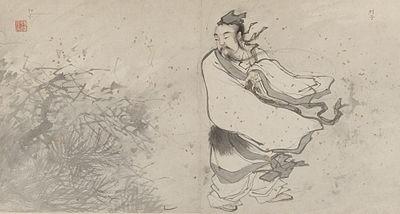
Author
Lie Yukou
Born 400 BC
Lie Yukou (Chinese: 列圄寇/列禦寇; pinyin: Liè Yǔkòu; Wade–Giles: Lieh Yü-k'ou; fl. ca. 400 BCE) is considered the author of the Daoist book *Liezi*, which uses his honorific name Liezi (Chinese: 列子; pinyin: Lièzĭ; Wade–Giles: Lieh-tzu; literally: 'Master Lie'). The second Chinese character in Yukou is written kou 寇 "bandit; enemy"; the first is written yu 圄 "imprison", yu 禦 "resist; ward off", or occasionally yu 御 "drive (carriage); ride (horse); control" (the Zhuangzi claims Liezi could yufeng 御風 "ride the wind"). Lie Yukou was born in the State of Zheng, near today's Zhengzhou, Henan Province.
**Source**: Lie Yukou on Wikipedia.
Wikipedia. Bibliographic data from Open Library.
Books by Lie Yukou
Most-read first
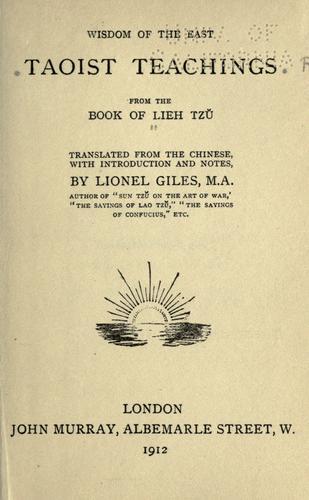
Taoist teachings from the book of Lieh Tzu
Liezi, 1912
- Tratado del vacío perfectoLiezi
Tratado del vacío perfecto
Liezi, 2003
Philosophes Taoïstes
Laozi, Zhuang Zhou & others, 1980
Las Mejores Leyendas Taoistas
Zhuangzi & Liezi, 2002
The book of Lieh-tzŭ
Liezi, 1960
- Jing dian tu duLiezi
Jing dian tu du
Liezi, 2003
- Liezi jiao shiLiezi
Liezi jiao shi
Liezi, 1975
- Liezi Zhang zhuLiezi
Liezi Zhang zhu
Liezi, 1813
Resshi
Liezi, 1912
- Xin yi Liezi du benLiezi
Xin yi Liezi du ben
Liezi, 1979
- Ying Song ben LieziLiezi
Ying Song ben Liezi
Liezi, 1884
- Lieh-tzuLiezi
Lieh-tzu
Liezi, 1965
- Liezi ji shiLiezi
Liezi ji shi
Liezi, 1965
- Traite du Vide ParfaitLiezi & Jean-Jacques Lafitte
Traite du Vide Parfait
Liezi & Jean-Jacques Lafitte, 1997
- Das wahre Buch vom quellenden Urgrund =Liezi
Das wahre Buch vom quellenden Urgrund =
Liezi, 1921
- Liezi zhu zi suo yin =Liezi
Liezi zhu zi suo yin =
Liezi, 1996
- 列子[ken]齋口義林希逸 & Liezi
列子[ken]齋口義
林希逸 & Liezi, 1659
- Liệt tử và Dương tửLiezi
Liệt tử và Dương tử
Liezi, 1973
Le Vrai Classique du vide parfait
Liezi & Benedykt Grynpas, 1996
- LieziLiezi
Liezi
Liezi, 1926
Reading Lie Yukou
- Which books by Lie Yukou can I find here?
This page currently brings together 20 catalogue works, including Taoist teachings from the book of Lieh Tzu, Tratado del vacío perfecto, Philosophes Taoïstes. This is a selection from our catalogue, not necessarily a complete bibliography. Open a work to compare editions and reviews.
Search this author- How are these books ordered?
The list uses catalogue reading-popularity data to put widely read works first. That is a discovery aid, not a claim that the first result is the author's best book or a recommended reading order.
- Where should I check a particular edition or translation?
Open the book's catalogue page and compare publisher, year, format, language and ISBN. Different editions of the same work can have different translators, introductions and page counts.