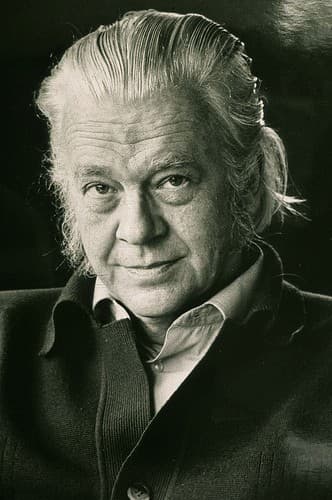
Author
E. F. Schumacher
1911–1977
Ernst Friedrich Schumacher was a German-born British statistician and economist who is best known for his proposals for human-scale, decentralised and appropriate technologies. He served as Chief Economic Advisor to the British National Coal Board from 1950 to 1970, and founded the Intermediate Technology Development Group in 1966.
Biography from Wikipedia (CC BY-SA). Bibliographic data from Open Library.
Books by E. F. Schumacher
Most-read first
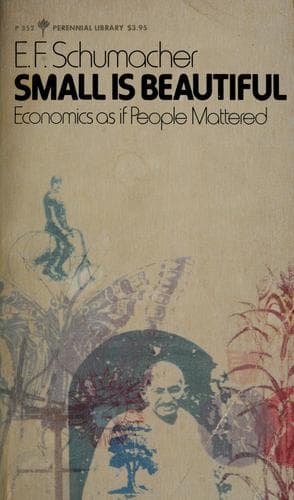
Small Is Beautiful
E. F. Schumacher, 1973
A Guide for the Perplexed
E. F. Schumacher, 1977
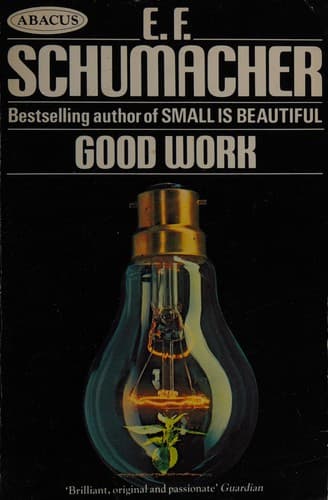
Good work
E. F. Schumacher, 1979

This I Believe
E. F. Schumacher, 1998
The Wisdom of Permanence
E. F. Schumacher, 2008
- Rich Countries - Poor CountriesE. F. Schumacher
Rich Countries - Poor Countries
E. F. Schumacher, 1969
Schumacher on Energy
E. F. Schumacher, 1982
- Ḳaṭan zeh yafehE. F. Schumacher
Ḳaṭan zeh yafeh
E. F. Schumacher, 1984

The Age of Plenty
E. F. Schumacher, 1974
- An Economics of PeaceE. F. Schumacher
An Economics of Peace
E. F. Schumacher, 2001
- Economic Development and PovertyE. F. Schumacher
Economic Development and Poverty
E. F. Schumacher, 1966
- Managing to SurviveE. F. Schumacher
Managing to Survive
E. F. Schumacher, 1975
People's power
E. F. Schumacher, 1974
- Roots of Economic GrowthE. F. Schumacher
Roots of Economic Growth
E. F. Schumacher, 1962
- Technology and Political ChangeE. F. Schumacher
Technology and Political Change
E. F. Schumacher, 1976
- Think About LandE. F. Schumacher
Think About Land
E. F. Schumacher, 1974
- What Will Planning Mean in Terms of Money?E. F. Schumacher
What Will Planning Mean in Terms of Money?
E. F. Schumacher, 1944
- Clean Air and Future EnergyE. F. Schumacher
Clean Air and Future Energy
E. F. Schumacher, 1967
- La Técnica puesta a pruebaE. F. Schumacher & Patricio H. Randle
La Técnica puesta a prueba
E. F. Schumacher & Patricio H. Randle, 1982
- International symposium "Energy, man and the environment", February 3-5, 1972E. F. Schumacher
International symposium "Energy, man and the environment", February 3-5, 1972
E. F. Schumacher, 1972
- Betrachtungen zur deutschen finanzreformE. F. Schumacher & Walter Fliess
Betrachtungen zur deutschen finanzreform
E. F. Schumacher & Walter Fliess, 1945
- Sāthāranasuk kap PhutthathamPrawēt Wasī, E. F. Schumacher & others
Sāthāranasuk kap Phutthatham
Prawēt Wasī, E. F. Schumacher & others, 1981
- The Schumacher lecturesE. F. Schumacher
The Schumacher lectures
E. F. Schumacher, 1980
- Future Is ManageableE. F. Schumacher
Future Is Manageable
E. F. Schumacher, 1978
- An Economics of PermanenceE. F. Schumacher
An Economics of Permanence
E. F. Schumacher
- Export Policy and Full EmploymentE. F. Schumacher
Export Policy and Full Employment
E. F. Schumacher, 1943
Reading E. F. Schumacher
- Which books by E. F. Schumacher can I find here?
This page currently brings together 26 catalogue works, including Small Is Beautiful, A Guide for the Perplexed, Good work. This is a selection from our catalogue, not necessarily a complete bibliography. Open a work to compare editions and reviews.
Search this author- How are these books ordered?
The list uses catalogue reading-popularity data to put widely read works first. That is a discovery aid, not a claim that the first result is the author's best book or a recommended reading order.
- Where should I check a particular edition or translation?
Open the book's catalogue page and compare publisher, year, format, language and ISBN. Different editions of the same work can have different translators, introductions and page counts.